Illuminating The Cave of Forgotten Dreams
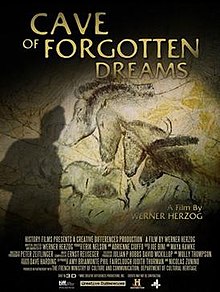
Werner Herzog’s 2010 film, Cave of Forgotten Dreams, is more than a lesson in art history; it is an enchanting look into the evolution of the human soul. Herzog takes the senses on a journey of wonder as he visits the 32,000-year-old paintings on the walls of the Chauvet Cave, named after its key discoverer. I stress the importance of this film because actually visiting the cave is prohibited, thus this film becomes a tourist attraction; it is the only opportunity for the public to encounter the forgotten dreams of primitive life. Located in the south of France, Herzog describes the cave in a way that could also apply to his film: The documentary itself “seems at first, nothing particularly special”, but after engaging your senses with the contents deep within, do you realize how remarkable the stories of these cave paintings are.
In 1994, two hikers were simply looking for hidden crevasses in the mountainous range of southern France. They began following an air draft that ran along the ground. When they reached the source of the draft, they rolled away a large boulder only to make “the greatest discovery in the history of human culture”. Preserved in pristine condition, the paintings done by Paleolithic artists have become the fascinating contents of a natural time machine from 32,000 years ago. Beautifully whimsical, the paintings are of various animals: bison, cattle, cave bears, deer, horses, hyenas, lions, and woolly mammoths, layered over a span of several thousand years.
Locked away and inaccessible to the public, Herzog was granted special access by the French government to play tour guide where he directs our only adventure inside this enchanting place. Given a few hours at a time to explore, researchers and scientists are allowed to map and interact with the historical masterpiece of the Chauvet. These limitations are in place to preserve the site and protect the explorer, since parts of the cave are unstable and emit large amounts of carbon-monoxide gas. In an interview, one archeologist seemed quite all right with the time constraints; he confessed to Herzog that once he was given 5 days to gather information but had to take the fifth day off to absorb the caves magnificence, and even still the powerful images lingered as he dreamt of running tigers the following night.
Time and Space become unfathomable within the enchanted cave. One Netflix user tried to put the passage of time into perspective in a way that is reflective of Herzog’s quirky antics in filmmaking:
I'm writing this sentence in the year 2010. Now imagine that someone came along in the year 7010 (some five thousand years later) and added this second sentence. Then the two sentences sit there side by side until the year 32, 010 when we come along and see those sentences for the first time. That's the span of time we have to grasp when watching this bewitching film.
This “bewitching” film is an experience like no other. Though I watched the film on a laptop in my own dark cave-like room, Herzog oddly screened the original documentary in 3-D. Unlike other hokey films of 2010 that used 3-D to increase ticket sales, i.e.: Step Up 3-D; Friday the 13th part II 3-D; and Shrek Forever After, Herzog’s use of the effect creates an absorbing impression like the one felt by the archeologist. In a scene of what Herzog refers to as “proto-cinema”, he shows us a herd of horses that were carefully drawn in sync with the rippling of the wall’s surface, and with 8 legs to depict movement. As he stalls on the image, the cave’s intimacy with the viewer increases. I began to visualize the scene and could almost hear the sound of their galloping hoofs. With the help of 3-D, I could have easily imagined the stampede coming to life, charging off the screen, and igniting a full sensory interaction.
As if the images aren’t entrancing enough, Herzog’s use of sound becomes a powerful tool in his efforts to delight the senses. The original score by Ernst Reijseger conjures emotional associations to the mysterious and majestic elements of the Chauvet. As the film rolls on, we are taken further inside the cave to visit various recessions and examine their ancient graffiti. Filmed with a small hand held 3-D camera, you take on an enclosed sense of actually repelling down and meandering through the narrow passages of the 1,300-foot long time capsule. As the camera slowly pans across the cave, its floor reveals layers of glistening concretions that cover the bones of animals long extinct and resemble something of another world. Herzog continues to slowly track the walls of the cave, and just when you think the pace of the film is growing slow and repetitive, Herzog’s peculiar tendencies chime in to play with sound by demanding silence to listen to the heartbeat of the cave. Although the haunting sound track interferes with the audience’s silence, Herzog’s suggestion that “the images are long forgotten dreams of the artists”, reminds us to be still. In that eerie moment, to take the time to stop, to reflect on what you are witnessing, and to imagine the artists in work all those years ago, will leave you in one of Herzog’s thought provoking states. You won’t be able to help but wonder whether the heartbeat you hear is your own, or if it belongs to cave.
Wanting to know what purpose the cave held for humankind, Herzog further guides an entertaining investigation of the human presence 32,000 years ago. His curiosity speculates probable uses for objects found within the region of a cave, suggesting an ancient appreciation for religion, music, and sport. I couldn’t help but laugh at a spear throwing demonstration, or wonder why the model of a primitive flute was playing The Star Spangled Banner. However, it is Herzog’s imaginative pursuits that made one particularly magnificent discovery within the depths of the cave. In an extremely fragile area, a stone protrudes from the ceiling and appears to present the only figure of a human in the cave. Due to the sensitivity of the area, the full image has never been completely seen by anyone, so it remains uncertain whether the image is indeed of a woman. Yet Herzog was successful in persuading authorities to grant him permission to lead us behind the stone. After fastening a camera to the end of a long pole, Herzog reveals what has been hidden from sight for long. To this day, I still experience the extraordinary affect of this cave as my mind continues to draw numerous connections between that hidden image and other instances in art and culture of thousands of years later. But how is it possible that this rare and peculiar image influenced such instances if it has remained unseen for long? Such a thought is just another mystery of the Chauvet cave.
Herzog leaves the audience with a bizarre post-script of nuclear mutated albino alligators, which turns the film into an even more unique experience. However, the strange suspicion Herzog shares provokes a thought that can be traced through out the entire documentary. With his proposal regarding the direction of the far far future, we can only hope that there will be an alligator with a creative mind and soul similar to Herzog’s.
If the thought of a documentary focused on ancient cave paintings sounds dull and boring, Herzog successfully creates a film on the topic that is anything but. He brings the magnificent images to life while crafting an intriguing masterpiece of his own. With such a vivid glimpse into primordial man, you will be so thoroughly overwhelmed by the astounding history of human culture that you will have no time for boredom. This is a tour you’ll want to take.